Scout Advisors, for owners and CEOs of established companies
Build a business that depends less on you and makes more money.
You hired good people and put a system in place, and everything important still comes back to you. Scout Advisors brings your leadership team evidence from your customers, your team, and your numbers, so they can choose the few changes that make the business more profitable and less dependent on you.
The assessment is the first step of every Scout Advisors engagement. It takes about three minutes and tells you where to look first.

What keeps you up at night?
- We’re busy, but we’re not more profitable. Why?
- I hired good people. Why does everything important still come back to me?
- Are we chasing the right priorities, or just the loudest ones?
- If I stepped back for a month, what would break?
Most owners who answer those questions fall into one of four patterns.
Top row: most decisions still come to you. Bottom row: few do.
Profit not improving
The Linchpin
Nothing moves unless you do.
Profit improving
The Workhorse
It’s growing, and you’re carrying it.
Profit not improving
The Treadmill
The team runs well. The numbers don’t move.
Profit improving
The Launchpad
The engine runs without you. The question is what to aim it at.
The assessment places you in one of these four.
You have tried EOS or a similar system, a consultant, a COO, a fractional executive, a peer group, or a coach. Each made the company better. The missing piece is evidence. Without it, the choosing still lands on you.
Who this is for
An established company, usually $5 million to $150 million in revenue, run by an owner, CEO, president, or GM.
An operating leader already in the seat, or one you are developing.
A leader ready to share control, not just to make the team more accountable.
A system you already run, such as EOS, Lean, Scaling Up, Pinnacle, 4DX, or your own. We work alongside it and add the evidence it runs on.
Not a fit yet
Start-ups, companies in survival mode, and leaders who want to keep every decision.
Why plans fail, and what we do instead
Where plans go wrong
What we do
- 1
The plan came from what the room already believed.
What we doWe bring evidence from your customers, your team (answered anonymously), and your numbers against your industry.
- 2
Nobody named the one problem the strategy had to solve.
What we doThe Truth Report shows where your team, your customers, and your numbers disagree, and names the problem.
- 3
No real alternatives, so the priority list never got short.
What we doWe lay out the real choices and trade-offs, and you choose three to five initiatives.
- 4
Nobody agreed on the trade-offs, so you kept deciding.
What we doYour leadership team makes the calls with you in the room, and the operating leader owns them.
- 5
Nothing tied the plan to profit or the value of the business.
What we doEvery initiative has an owner, a 90-day rock, a measure, and a target on the numbers that move your value; it exports into EOS or the system you run.

What working with us looks like
- 1
“We figured out what was really holding us back.”
- Your numbers against your industry.
- Anonymous surveys of your team and your customers.
- The Truth Report and one agreed problem to solve.
 Where You Stand TodayExample
Line You Median Top quarter Gap to median Revenue growth 4.1% 6.0% 11.2% Gross margin 27.4% 31.0% 36.5% $1,008,000 a year EBITDA margin 6.2% 9.5% 14.0% $924,000 a year Operating expenses, % of sales 21.2% 21.5% 18.0% Payroll, % of sales 24.8% 22.0% 19.5% $784,000 a year Receivables, % of assets 31% 26% 21% Six of the twelve lines. The full table is built from your numbers.
An example with made-up numbers for a made-up company. 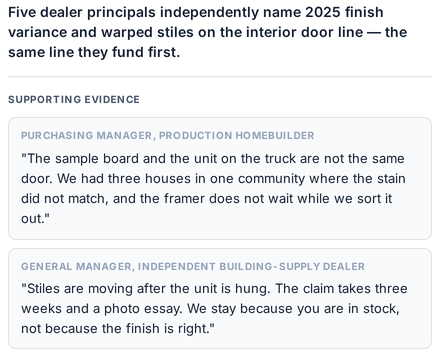
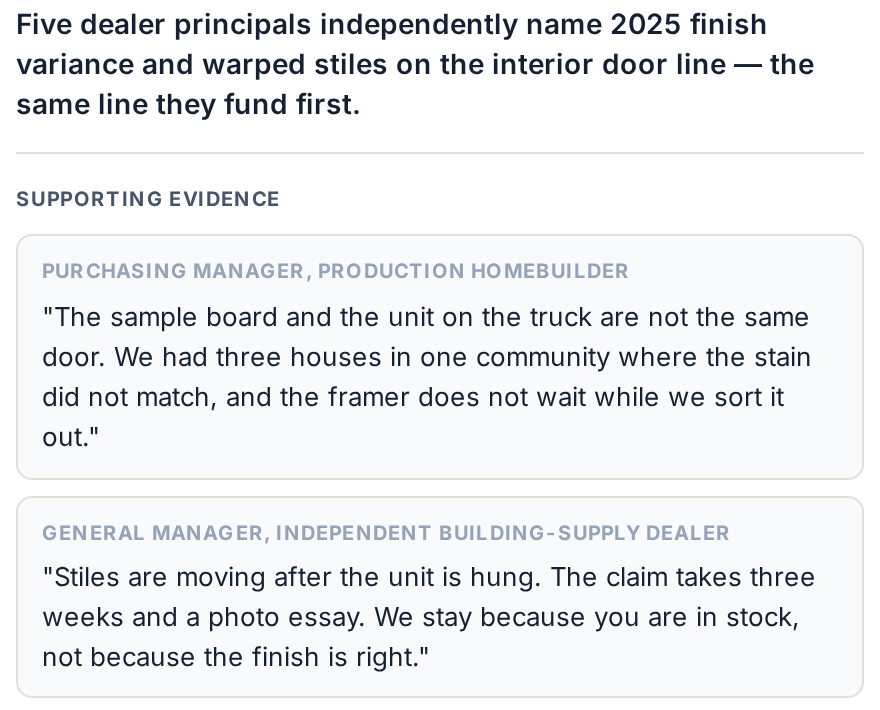
The evidence behind one statement in the Truth Report: what customers said, in their own words. From Scout it, shown with a demonstration company. - 2
“We chose a few changes that would make us more profitable and less dependent on me.”
- The real choices and trade-offs, in the room with your team.
- Three to five initiatives with owners, rocks, and measures.
- The projected movement in your numbers and your value.
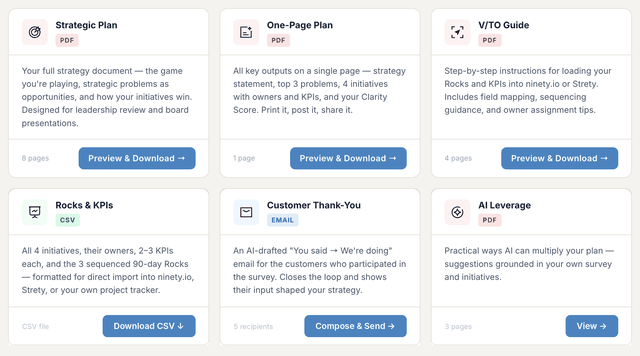
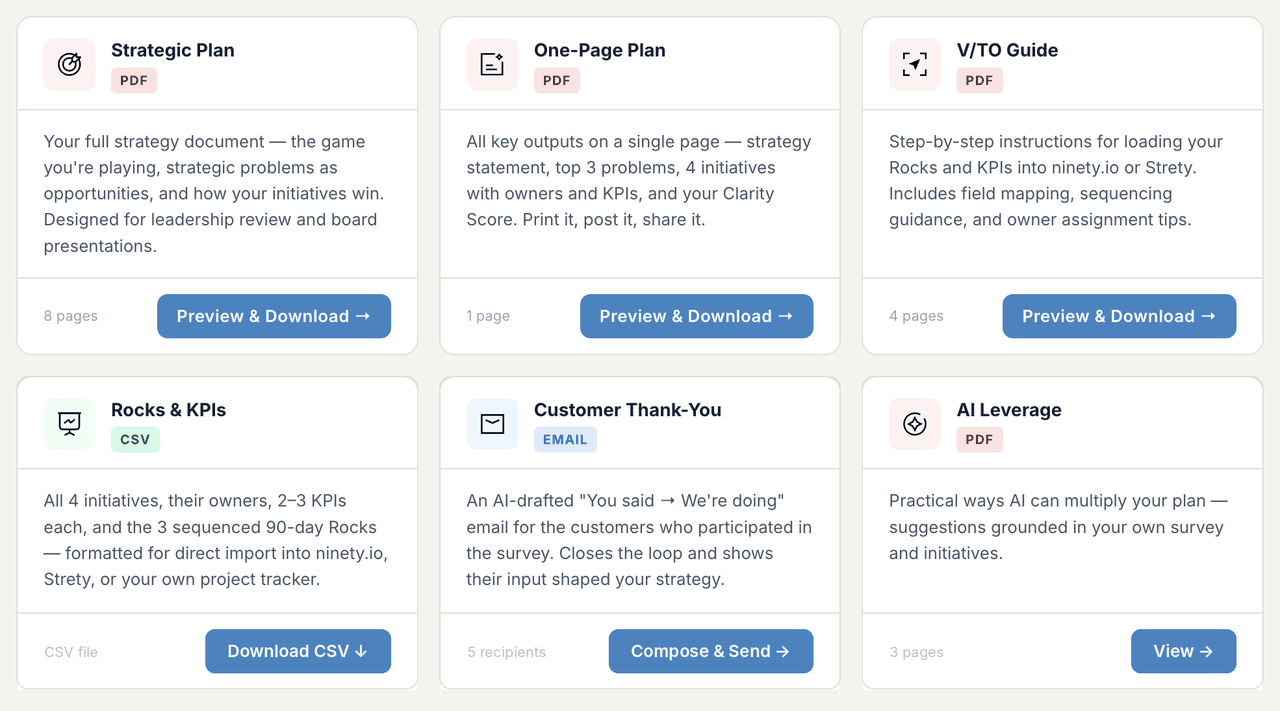
What the team takes away: the plan, the one-page plan, the rocks and KPIs for EOS or ninety.io, the customer thank-you, and the AI Leverage Report. - 3
“We got my team leading those changes and have a system to keep checking what was actually working.”
- The plan runs in EOS or the system you already use.
- A quarterly Pulse shows what moved and what did not.
- Your operating leader runs it; we come back when it matters.
What Changed This QuarterExampleThird quarter Pulse, run by the operating leaderLines that moved
Gross margin, 27.4% to 28.6%
EBITDA margin, 6.2% to 7.0%
Lines that did not
Payroll, still 24.8% of sales
Initiatives
Price custom work for what it costs. On track.
Sell the standard line to best-fit customers. Behind.
Operating leader approves quotes. Done.
Decisions taken
Turned down a one-off order from a customer outside the core. Decided by the operating leader.
An example with made-up numbers for a made-up company.
We walk alongside you for a season of three to six months.
Scout it software is the system your team keeps running.
Built for the operating leader who will run it
- The evidence to make the calls without checking upstairs.
- The plan, with decision rights and limits written down.
- The quarterly check that makes their judgment visible.
Proof
15%
Rise in company value in under 18 months
Columbia Forest Products, a 2,100-employee ESOP where Jon is CEO coach.
At Columbia Forest Products, the leadership team took over the two decisions that had been stalling on the CEO’s desk: consistent quality and customer engagement. Those two items had been holding the company back. In less than 18 months the share price rose about 15 percent.
600%+
Profitability improvement
Beta Fueling Systems, owner and CEO.
Danaher
Greatly increased core growth in each operating division
The method our founder helped deploy.
Companies we work with




Scout Advisors helped us gather the right customer insights, identify our strengths, and align our success with our customer’s success for a winning five-year growth plan. Our focus is clear and key metrics and accountability are in place.
Greg Pray, CEO, Columbia Forest Products, a 2,100-employee ESOP
Scout helped us identify the gaps between where we envision ourselves being as a business and where we are today, and gave us actionable insights to close those gaps in meaningful and measurable ways.
Luke Lucey, CEO, Whole Man Health
I’ve led and facilitated strategic planning for years as both a founder and an executive coach, and Scout is unlike anything I’ve experienced. It shifted the conversation from opinions to evidence, and made blind spots impossible to overlook. This is the process I would put in front of any executive leadership team.
John Tomlinson, Founder, Whole Man Health
Our guides have run companies, sat on the owner’s side of the table, and spent years inside operating companies helping leadership teams choose. Meet your guides.
Meet your guides
“I was an owner for years. I worked hard to build a good team, I was still carrying too much, and I was not sure all that effort was making the business more profitable.”

Jon DeLine
Founder and Lead Guide
Ran Beta Fueling as CEO. Worked inside Danaher, where the method he helped deploy greatly increased core growth in each operating division. Advises Columbia Forest Products.

Debbie DeLine
Operations and Product Guide
Thirty years in operational excellence. Cut lead times by more than half at Beta Fueling, and designs how Scout it works for the operating leader.

Richard Pan
Technical Guide
Builds Scout it and the AI behind it, with the rule that nothing reaches a leadership team without the evidence it rests on.
After the season, your operating leader runs it, and we come back when it matters.
What it costs
How we work together, and what it costs, depends on your company. We cover both in the Strategy Session.
What a point of margin is worth
Revenue last year
At $15 million to $50 million in revenue, each point of EBITDA margin is worth $150,000 to $500,000 a year.
This is arithmetic, not a forecast. One percent of $15 million is $150,000, and one percent of $50 million is $500,000.
Most companies sit several points below the top quarter of their industry. In the Strategy Session we put your real numbers against your industry’s median and top quarter, so you can see your gap in dollars.
What happens next
- 1Take the free assessment. It takes about three minutes.
- 2If Scout fits, book the free Strategy Session. Bring your operating leader if you like.
- 3Decide together whether to go on.
The Strategy Session is private. You can have it before anyone else knows Scout is being considered.
Two years from now, the business may be bigger, but it still needs you just as much, and the profit still does not make it worth it.
Questions leaders ask
Does this replace EOS or the system we run?
No. We work alongside the system and the advisors you already have. We add the evidence for choosing the right priorities. We do not replace the rhythm you already run.
How is this different from EOS, a peer group, or a consultant?
Each of those helps your team run better. We add what they do not: what your customers, your team, and your numbers say, so your leaders agree on the one problem to fix. You keep whoever you already use.
Who should take the assessment?
The owner or CEO should take it. The operating leader can take it too, and the differences between the two sets of answers are useful.
What does it cost?
How we work together, and what it costs, depends on your company. We cover both in the Strategy Session.
How long does it take?
Scout Advisors walks alongside you for a season of three to six months, and after that your operating leader runs a short Pulse every quarter.
What if we are not a fit?
You get your assessment results and one page on what to do first, and we tell you plainly.